Glass Railing Systems in Malaysia: The Complete Guide
Quick Answer
Glass railing systems in Malaysia cost RM 280–550 per running metre installed, depending on configuration. Four main types exist: frameless (most premium), semi-frameless, base-shoe (aluminium channel base), and post-mounted (stainless steel posts). All glass must be 12mm toughened or 10mm+10mm laminated for safety. JWE Premier installed 20,000+ sq ft at Toppen Shopping Centre.
A complete guide to glass railings (also called glass balustrades) in Malaysia: frameless, semi-frameless, base-shoe, and post-and-glass systems. Engineered for safety, designed for impact, fabricated for Malaysian climate. Includes our 20,000+ sq ft Toppen Shopping Centre installation case study.
In This Guide
- What is a glass railing?
- Types: frameless, semi-frameless, base-shoe, post-and-glass
- Malaysian standards and UBBL compliance
- Glass specification: toughened and laminated
- Applications: balcony, staircase, pool, commercial
- Case study: Toppen Shopping Centre
- Pricing in Malaysia (2026)
- Frequently asked questions
What is a Glass Railing?
A glass railing (also called glass balustrade or glass guardrail) is a fall-protection barrier system where the primary infill is structural glass instead of vertical balusters or solid panels. Glass railings are used on balconies, staircases, pool decks, terraces, and commercial atriums where unobstructed views are desired but building codes require a protective barrier.
JWE Premier Engineering has been fabricating and installing glass railings in KL and across Malaysia since 1994. Our portfolio includes some of the country's largest installations — most notably the 20,000+ sq ft glass railing project at Toppen Shopping Centre in Johor Bahru, one of the largest single-project glass railing installations in the country.
Types of Glass Railing Systems
Frameless Glass Railing
Glass panels held by stainless steel point fixings or spigots at the base, with no top rail or vertical posts. Maximum visual transparency. The premium aesthetic. Requires thicker glass (typically 12–17.52mm laminated) and more precise installation.
Base-Shoe Glass Railing
Glass panels inserted into a continuous aluminium or stainless steel base channel. The base channel is mechanically fixed to the structure. Top can be frameless, or capped with a slim handrail. The most common commercial system.
Post-and-Glass Railing
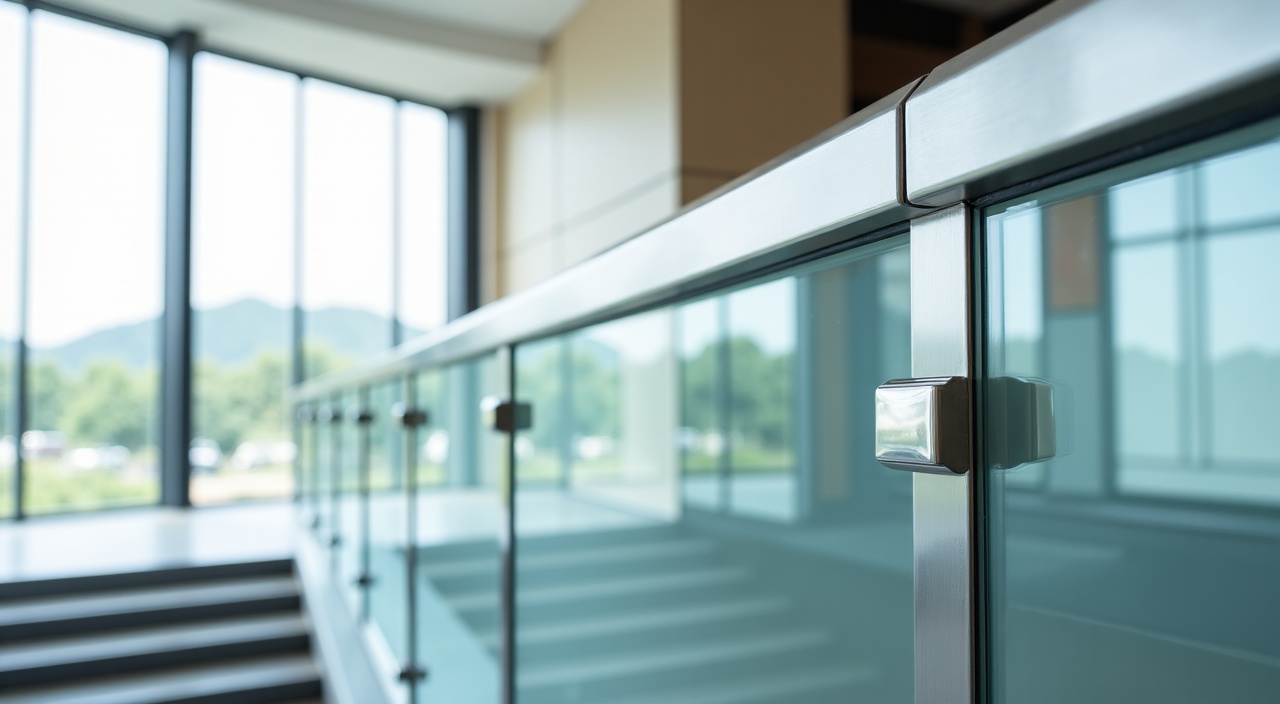
Glass panels mounted between vertical stainless steel or aluminium posts. Posts are mechanically fixed at intervals (typically 600–900mm). The most cost-effective option. Common in residential balconies and commercial offices.
Semi-Frameless Glass Railing
Glass panels with a continuous top rail (stainless steel or aluminium) but no vertical posts. The top rail provides structural edge protection while maintaining the visual openness of glass. Mid-range price and performance.
Malaysian Standards and UBBL Compliance
Glass railings in Malaysia must comply with the Uniform Building By-Laws (UBBL) 1984 (By-Law 38) and the relevant MS standards. The key requirements:
- Minimum height: 1,075mm for residential, 1,100mm for commercial, 1,200mm for public assembly areas
- Load resistance: 0.75 kN/m horizontal load at handrail height for residential; 1.5 kN/m for public assembly
- Glass specification: Toughened (tempered) or laminated safety glass required. Wire glass, annealed glass, and acrylic are NOT acceptable.
- Glass thickness: Typically 10mm toughened, 12mm toughened, or 11.52–17.52mm laminated toughened
- Edge protection: Top rail required where glass is the only barrier element, or where fall height exceeds 12m
- Gap limits: No opening greater than 100mm (so a 100mm sphere cannot pass through)
JWE Premier provides calculation certificates and structural drawings for all commercial glass railing installations. Our engineering documentation satisfies local authority submission requirements (DBKL, MBSA, MPKJ, MBJB).
Glass Specification
Choosing the right glass is the single most important decision in a glass railing project. The two options are toughened (tempered) or laminated toughened:
- Toughened (tempered) glass: 4–5x stronger than float glass. Breaks into small harmless granules. Cannot be cut after toughening. Standard for residential and commercial applications.
- Laminated toughened glass: Two toughened panes bonded with a PVB or SGP interlayer. Holds together when broken, providing residual fall protection. Required for high-rise applications, public assembly, and frameless systems.
- Heat-strengthened glass: 2x stronger than float. Less common in Malaysia, but used for very large panels where full toughening is impractical.
For frameless railings, JWE Premier mandates laminated toughened glass (typically 11.52mm or 17.52mm). The interlayer prevents fall-through if the glass is broken — the critical safety requirement for barrier systems.
Applications in Malaysia
- Residential balconies: Frameless or semi-frameless systems for condominiums and landed properties. Frame in stainless steel 316 for coastal exposure.
- Staircases: Internal and external stair balustrades. Often frameless with channel-fixed glass.
- Pool decks and fences: Glass pool fencing for compliance with MAHB (Malaysia Akta Hambatan) requirements. Frameless systems with self-closing hinges.
- Commercial atriums: Large-format glass barriers in shopping centres, hotels, and offices. Toppen Shopping Centre is our flagship case study.
- Sky bridges and viewing platforms: Structural glass barriers in high-rise developments and tourist attractions.
- Car park edges: Glass wind screens and safety barriers.
Case Study: Toppen Shopping Centre
JWE Premier was contracted for the glass railing works at Toppen Shopping Centre, Johor Bahru. The project required 20,000+ sq ft of glass railing across multiple levels of the mall — one of the largest single-project glass railing installations in Malaysia.
Key challenges and solutions:
- Volume fabrication: 600+ glass panels fabricated in our Taman Danau Desa workshop over 4 months
- Consistent quality: All panels heat-soaked to remove nickel-sulphide inclusions, eliminating risk of spontaneous breakage
- Handrail coordination: Stainless steel 316 handrails sourced from a single supplier to ensure colour match across the entire project
- Site logistics: Phased delivery to match the main contractor's level-by-level handover
- Compliance: Full structural calculation package submitted to the consultant for authority approval
The project was completed on schedule and has been operational since 2019 with zero reported railing incidents.
Pricing in Malaysia (2026)
Glass railing pricing varies significantly by system type, glass specification, and finish. Typical 2026 Klang Valley rates for supply-and-install:
| System | Glass | Indicative Price (per running ft) |
|---|---|---|
| Post-and-glass (stainless steel posts) | 10mm toughened | RM 220–320 |
| Semi-frameless (top rail) | 12mm toughened | RM 350–500 |
| Base-shoe frameless | 12mm toughened | RM 450–650 |
| Frameless point-fixed | 12mm laminated | RM 600–850 |
| High-rise laminated | 17.52mm laminated | RM 850–1,200 |
For an accurate quote, send us your linear footage, location, and intended glass specification.
Frequently Asked Questions
What is the strongest type of glass railing?
Laminated toughened glass railings are the strongest. The toughened glass provides impact resistance (4–5x stronger than float), while the laminated interlayer holds the panel together if broken. For high-rise and public assembly, 17.52mm laminated toughened is the gold standard.
Are glass railings safe for children?
Yes. UBBL 1984 requires gaps no greater than 100mm (preventing child head passage), and laminated glass prevents fall-through if broken. JWE Premier's residential installations include anti-climb top rail details where required.
Stainless steel 304 vs 316 — which is better for Malaysia?
Stainless steel 316 is recommended for all exterior applications and within 5km of the coast. It contains molybdenum for chloride resistance. Stainless steel 304 is acceptable for fully interior applications. JWE Premier defaults to 316 for all balcony and exterior installations.
How long does glass railing installation take?
A typical residential balcony (20–30 running feet) takes 2–3 days from start to finish. Large commercial projects like Toppen Shopping Centre require 3–6 months of phased installation matching the main contractor's schedule.
Can glass railings be repaired if damaged?
Individual glass panels can be replaced without dismantling the entire railing. JWE Premier stocks common sizes and finishes for emergency replacement. Larger panels or non-standard finishes require 4–6 week lead time.
Planning a Glass Railing Project?
Send us your drawings, dimensions, or a brief description. We'll provide a structural recommendation and a written quote within 48 hours.