Aluminium Box Louvres
Large-scale external aluminium box louvre fabrication and installation for commercial towers, carpark podiums, and luxury residences — engineered for tropical wind loads, thermal expansion, and long-term facade performance.
Controlling the Sun, Defining the Facade — an Engineering Exercise
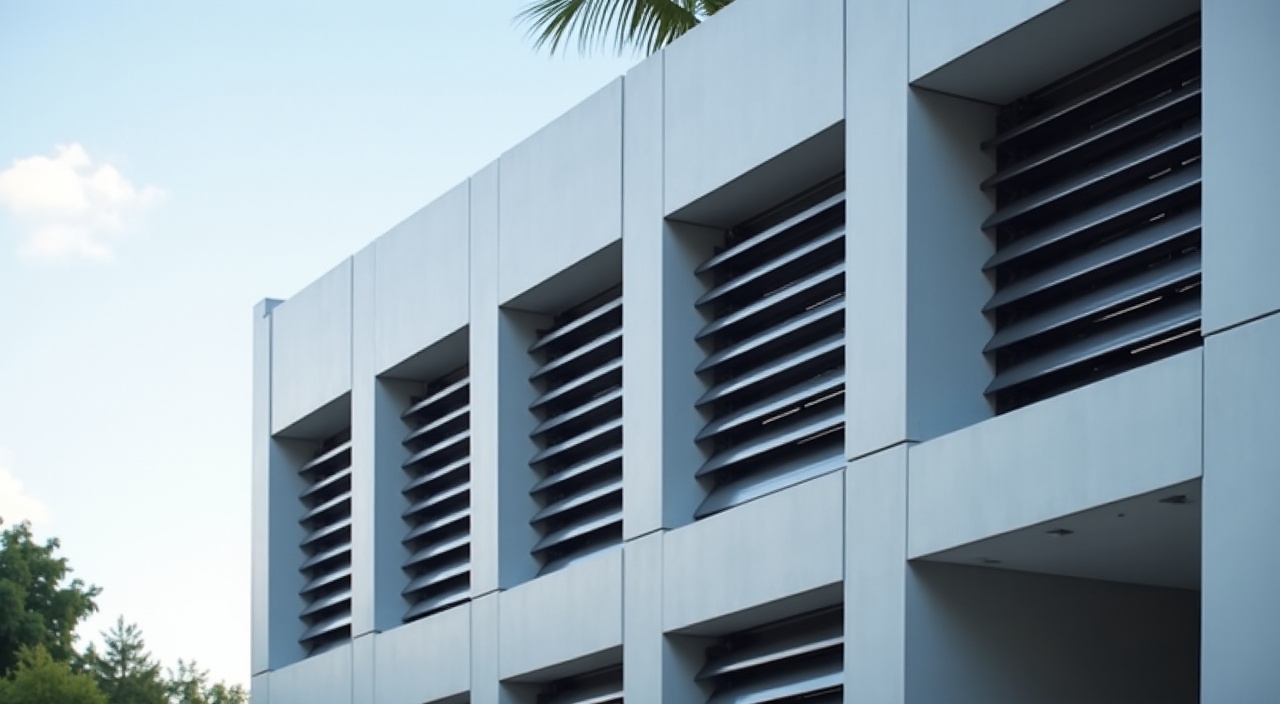
Aluminium box louvres — also called architectural fins or brise-soleil — are prominent structural elements in modern commercial architecture, serving both a functional and aesthetic purpose. Functionally, large horizontal or vertical fins intercept direct solar radiation before it strikes the glass facade, dramatically reducing the building's cooling load and improving occupant comfort. Architecturally, the rhythm of bold aluminium fins defines the building's character and gives the facade visual depth that flat glass alone cannot achieve. Unlike the louvre doors used for utility access, box louvres are fully external, structurally loaded elements that must be engineered for wind forces and thermal expansion — not just fabricated to size.
External aluminium box louvres installed on the facade of a multi-storey building behave like sails under wind load. Each fin presents a significant surface area perpendicular to the prevailing wind, generating large bending forces at the fixing bracket. A fin that is not designed for its specific wind exposure — based on building height, location, and orientation — will deflect excessively or eventually fail at the bracket. Additionally, long runs of aluminium exposed to direct tropical sun undergo substantial thermal expansion and contraction diurnally. Without correctly designed expansion joints and slip connections in the fixing system, this cycling stress buckles the facade over time. JWE engineers both considerations into every box louvre installation — wind load bracket design and thermal expansion provision are not optional extras.
Wind Load Engineering
Bracket design and fixing schedules are specified to the actual wind exposure of the installation — building height, location, and fin orientation all affect the design load. We do not use generic bracket specifications for external structural elements.
Thermal Expansion Provision
Slip-joint connections and expansion gaps are incorporated at calculated intervals along the run to absorb the thermal movement of aluminium exposed to direct tropical sun. Facades without expansion provision buckle seasonally and suffer fatigue cracking at fixing points over years of cycling.
Custom Powder Coat Finishes
High-durability polyester powder coat in any RAL colour, or anodised finish, provides UV and acid rain resistance for an external facade element that will not be easily repainted. Finish selection is critical — external aluminium that fades or chalks within 5 years is a common quality failure.
In-House Fabrication
Factory-Made, Site-Assembled
JWE fabricates box louvre sections at our own factory, where dimensional accuracy and finish quality can be controlled in a workshop environment. Large-scale facade installations are pre-fabricated into manageable site-assembly units, reducing time at height and ensuring consistency across the full installation.
Get a Box Louvre Quote
Share your building height, fin orientation, approximate run length, and finish preference. We will assess the structural requirements and provide a comprehensive quotation covering fabrication and installation.
Request a QuoteOr call 012-2640888
Common Applications
- Corporate tower sun shading
- Carpark podium ventilation screens
- Residential bungalow facade fins
- Commercial building facade feature
- Horizontal & vertical arrangements
Frequently Asked Questions
What is the structural design process for box louvres on a high-rise facade?
For high-rise applications, we work from the architectural drawings and building wind load data provided by the structural engineer. We design the bracket fixing schedule, fin section size, and expansion joint spacing to meet the stated wind load. The fixing positions are coordinated with the structural concrete or steel that the brackets anchor into — we verify anchor capacity before proceeding. For towers where no wind load data is available, we calculate based on UBBL wind speed zones and building height. The design documentation is provided with the quotation so the client and their consultants can review it before works begin.
Can you replace or repair existing box louvres that are corroding or sagging?
Yes. Sagging box louvres are typically caused by bracket failure — either the original brackets were under-specified, or the anchors into the concrete have failed due to carbonation or corrosion. We inspect the existing installation, identify the failure mode, and either replace the brackets with correctly specified ones (if the aluminium sections are intact) or replace the full installation. Individual sections can often be replaced without disturbing the entire run, reducing the scope and cost of rectification.
How long does a box louvre facade installation take?
A typical commercial facade installation involves parallel activities: factory fabrication of the aluminium sections (2–4 weeks depending on quantity) and site preparation of bracket anchors. Once fabrication is complete, the installation rate on site is typically 50–150 linear metres per week depending on access complexity, height, and section size. We provide a programme schedule with the quotation. For buildings where facade access by gondola or mobile platform must be coordinated with building management, we incorporate those constraints into the schedule.