
Aluminium Louvre Doors
Fixed and adjustable aluminium louvre systems for M&E rooms, bin centres, gas enclosures, and utility areas — maintaining cross-ventilation while providing visual screening and structural security.
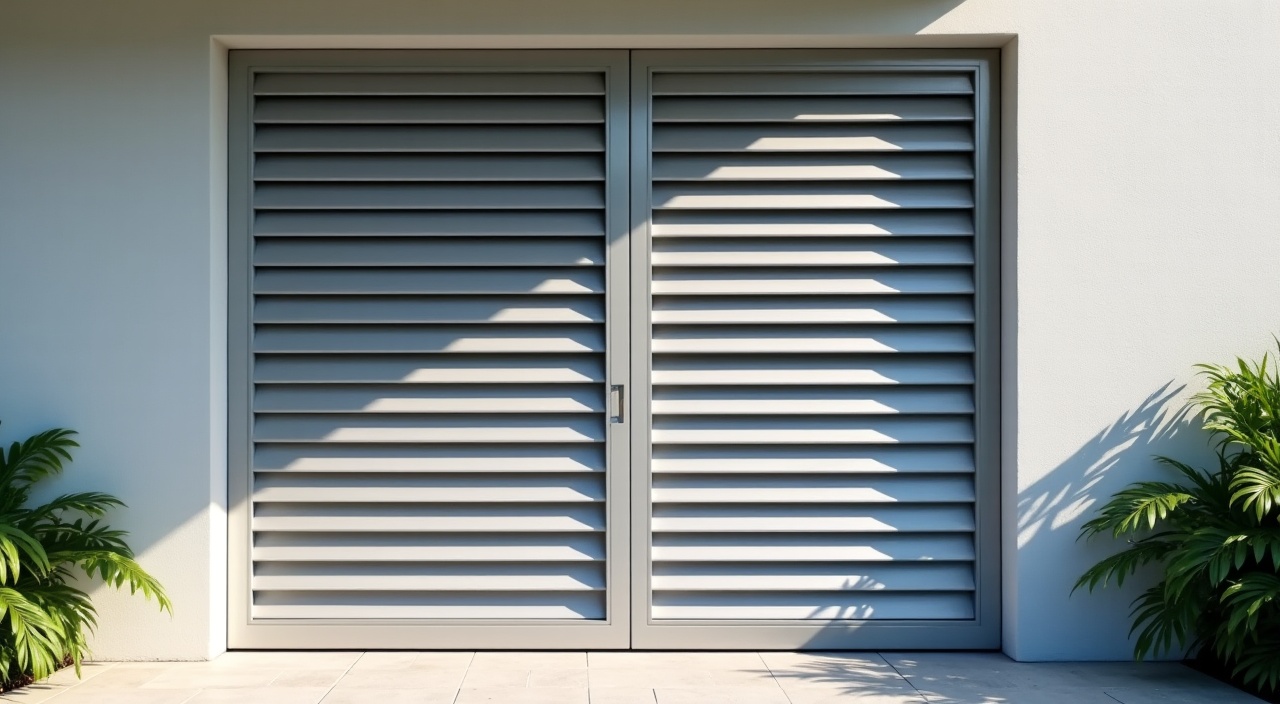
Managing Airflow and Sightlines in Utility Spaces
Certain building zones require continuous ambient ventilation as a functional or safety requirement — mechanical and electrical rooms housing chillers and generators need massive air intake; gas storage enclosures are subject to strict cross-ventilation regulations; bin centres and refuse rooms require odour dissipation without exposing the area to public view. A solid aluminium door blocks airflow entirely. A conventional open grille provides ventilation but no visual screening and minimal security. Aluminium louvre doors resolve this conflict by integrating angled aluminium blades into a secure structural frame, allowing airflow while blocking direct sightlines and controlling access.
JWE fabricates louvre doors in both fixed-blade and adjustable configurations. Fixed blades — set at a predetermined angle — provide a defined free-area percentage for ventilation calculations and cannot be tampered with from outside. Adjustable blade systems allow the ventilation rate to be modulated from inside the space, useful for areas where airflow requirements vary seasonally or operationally. Both configurations use blades that are structurally fixed into heavy-duty aluminium stiles, forming a rigid barrier against unauthorised access. The entire assembly is powder-coated to match the surrounding architectural facade — a louvre door should look like a deliberate design element, not an afterthought.
Controlled Free Area
Blade angle and spacing determine the free-area percentage — the proportion of the aperture that is open to airflow. We design to your ventilation specification, whether mandated by UBBL, M&E design, or safety codes for gas enclosures.
Visual Screening
Angled blades block direct sightlines into utility and service areas while allowing airflow. The blade angle is designed so that the interior is not visible from standing eye level outside, maintaining visual order in public-facing areas of commercial buildings.
Architectural Finish Match
Powder coating in any RAL colour allows the louvre door to match or complement the surrounding facade finish. A well-specified louvre door is a deliberate architectural element — not an industrial-looking utility installation interrupting the building's visual language.
In-House Fabrication
Custom Sizes & Blade Configurations
Louvre doors for utility openings are almost always non-standard sizes. JWE fabricates to exact aperture dimensions at our own factory — no standard-size compromises, no wait for external fabricators. Blade angle and spacing are specified to your ventilation requirement.
Get a Louvre Door Quote
Provide the aperture dimensions, application type (M&E room, bin centre, gas enclosure, etc.), and any ventilation free-area specification. We will design and quote accordingly.
Request a QuoteOr call 012-2640888
Common Applications
- M&E rooms (chiller, generator)
- Bin centres & refuse rooms
- Gas storage enclosures
- Pump & riser rooms
- Carpark ventilation screens
- Kitchen exhaust enclosures
Frequently Asked Questions
What free-area percentage is required for an M&E room?
Free-area requirements for mechanical and electrical rooms are typically specified by the building's M&E engineer based on the equipment heat load and UBBL ventilation standards. Standard architectural louvre blades at 45° provide approximately 40–50% free area; blades at shallower angles provide more. We design to your M&E specification — provide us with the required free-area percentage and aperture size, and we will confirm the blade configuration that achieves it.
Can louvre doors be made rain-proof?
Standard louvre blades angled downward at 45° prevent rain entry under normal rainfall. For exposed locations subject to wind-driven rain (high-floor carpark screens, coastal buildings), we use a deeper blade profile with a rain deflector lip that prevents water entry even under driven conditions. Rain rejection and ventilation performance involve a trade-off — we advise on the correct blade type based on your location's exposure.
How are louvre blades secured against tampering or forced entry?
Our louvre blades are fixed into the aluminium stiles with machine-threaded fasteners accessible only from inside the secured area. The stile-and-frame assembly is installed into the structural opening using concealed fixings into the wall. The frame rigidity and blade attachment method together make blade removal from outside the building very difficult without power tools — which would be audible and time-consuming. For high-security applications, we can specify additional anti-tamper measures such as internal welded blade flanges.