
Tempered Glass Doors
Heavy-duty frameless tempered glass swing and sliding doors for commercial entrances, office lobbies, and high-traffic retail — patch fittings, floor springs, door closers, and acoustic drop seals specified to the application and traffic volume.
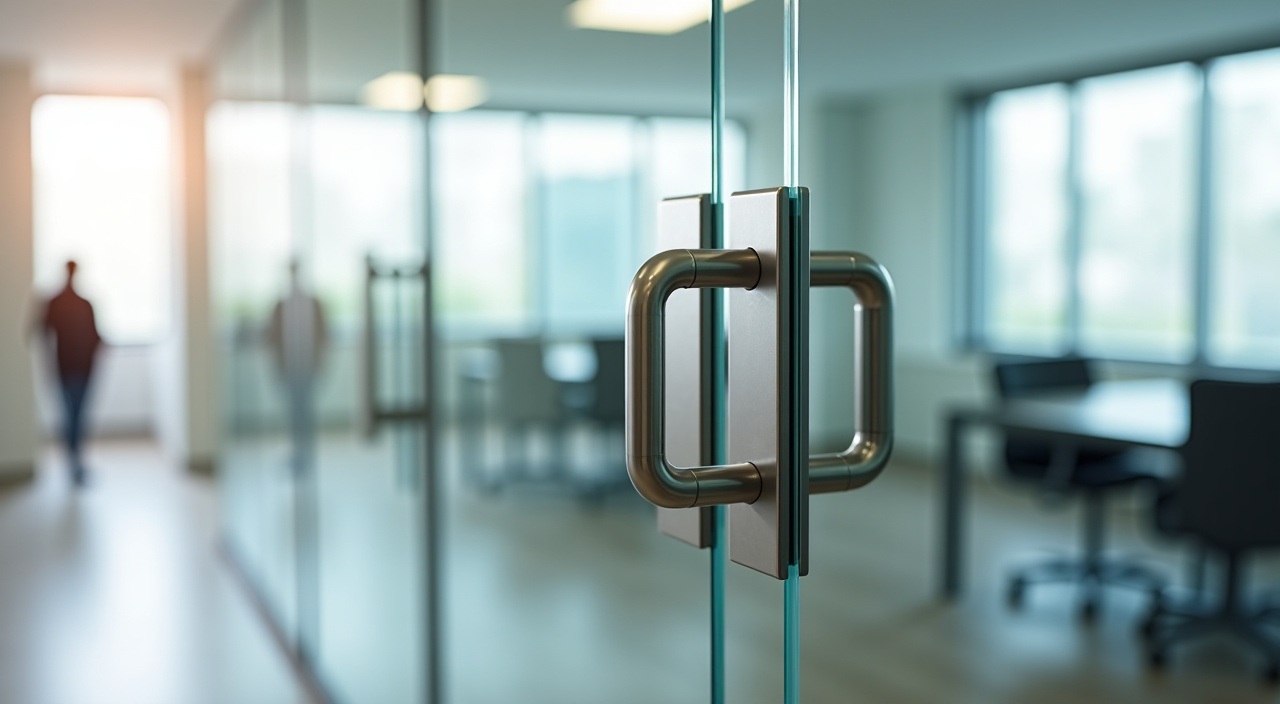
Hardware is the Door — the Glass is Only the Panel
A frameless tempered glass door makes an immediate architectural statement — no visible frame, no visual interruption between interior and exterior, the full transparency of glass from threshold to header. It is the defining entrance element of a contemporary commercial lobby, a high-end retail fitout, or a premium office reception. But the quality of a frameless glass door is almost entirely determined by the hardware specification: the patch fittings that clamp the glass, the floor spring or overhead closer that controls the swing, the lock cylinder and handle. A beautiful glass panel installed with cheap patch fittings and a poorly calibrated closer will squeak, drift open, fail to latch, and begin to feel wrong within months of opening.
JWE specifies and installs frameless glass doors to commercial-grade standards — not residential ones. Our patch fittings are forged stainless steel, not cast zinc. Our floor springs are hydraulic units from reputable manufacturers, not the economy friction pivot types that cannot be recalibrated without replacement. For office meeting rooms and private areas requiring acoustic privacy, we install acoustic drop seals in the door bottom rail — a neoprene blade that drops automatically when the door closes to seal the floor gap, reducing sound transmission significantly. We also supply and install automatic sliding glass doors for retail and lobby entrances where a hands-free entry experience is required. Every frameless glass door installation begins with the correct hardware specification, not the cheapest one available.
Heavy-Duty Patch Fittings
Forged stainless steel patch fittings clamp the glass panel at top and bottom, transferring all door load to the structural frame rather than through the glass edge. We specify fittings rated for the door weight and traffic volume — commercial lobbies require heavier-duty units than residential applications.
Hydraulic Floor Springs
Concealed hydraulic floor springs control door swing speed and ensure positive latching on every cycle. Unlike friction pivots, hydraulic units can be fine-adjusted for closing speed and backcheck without disassembly. We install floor springs from reputable manufacturers with a documented service and replacement parts network in Malaysia.
Acoustic Drop Seals
For meeting rooms and private offices requiring acoustic privacy, automatic drop seals are integrated into the door bottom rail. The neoprene blade drops to seal the floor gap when the door closes and lifts automatically when the door opens — no manual adjustment required and no floor drag that causes premature seal wear.
In-House Fabrication
Custom Sizes, Non-Standard Openings
JWE fabricates tempered glass door panels in-house, allowing us to produce non-standard sizes that off-the-shelf door suppliers cannot supply. Heritage shopfront openings, oversized lobby entrances, and odd-height commercial fitouts are routine. Glass is cut, edged, drilled, and tempered to exact dimensions before hardware is fitted.
Get a Glass Door Quote
Tell us the opening width and height, swing direction, traffic volume, and whether acoustic performance is required. We specify the glass thickness and hardware grade and provide a full quotation.
Request a QuoteOr call 012-2640888
Common Applications
- Office main entrance lobbies
- Retail shopfront entrances
- Hotel room & corridor doors
- Boardroom acoustic doors
- Glass partition integrated doors
- Spa & wellness facility doors
Frequently Asked Questions
What glass thickness is used for frameless commercial glass doors?
Standard frameless glass doors use 10mm or 12mm fully tempered glass. 10mm is appropriate for single-leaf doors in normal commercial use. 12mm is specified for oversized panels (wider than 1,000mm or taller than 2,800mm), high-traffic entrances, or where the door needs to resist significant wind pressure or crowd loading. The glass acts as a structural element in a frameless system — the thickness selection is an engineering decision, not just an aesthetic one. We specify based on your opening dimensions and application.
Can a frameless glass door be fitted with electronic access control?
Yes — frameless glass doors are routinely integrated with card readers, fingerprint readers, and electromagnetic locks for access-controlled office entrances. The electromagnetic lock is mounted at the header (top of the door frame) and holds the door closed until an authorised credential is presented. The door hardware must be specified to accommodate the lock housing, and the floor spring must be coordinated with the electrical release timing. We install glass doors with pre-coordination for access control systems installed by your IT or security contractor.
Why does a glass door swing open on its own or fail to latch properly?
Self-opening or failure to latch is almost always a floor spring calibration problem. Hydraulic floor springs have adjustable closing speed and latch action — if the hydraulic resistance has reduced due to oil degradation, or if the spring was never calibrated correctly after installation, the door will not develop enough closing force to reach the latch position. In some cases, a worn or misaligned pivot pin causes the door to hang out of plumb, creating a gap at the latch point. Our maintenance team diagnoses and recalibrates floor springs without replacement where the unit is still serviceable.